Removal of Nitrates from Water Using Adsorption Techniques (REMOVAD)
General Overview
Nitrate pollution is a growing environmental challenge, particularly in agricultural regions where intensive fertiliser use leads to water contamination and ecosystem degradation. REMOVAD aims to develop sustainable, efficient, and circular-economy‑based solutions for nitrate removal using adsorption techniques. The project evaluates two novel adsorbents — one synthetic and one derived from agricultural waste — to optimise their performance, assess their environmental impact, and assess whether they can be used within existing European regulations.
Purpose and Significance
Nitrates are among the most widespread water pollutants, posing risks to human health and aquatic ecosystems, and contributing to climate disruption. Current treatment methods are often costly or generate secondary waste. REMOVAD addresses this gap by exploring adsorption as a low‑cost, scalable, and environmentally friendly alternative.
The project aligns with EUniWell’s mission to promote environmental well‑being, sustainability, and circular use of resource.
Implementation Method and Timeline
The project brings together four EUniWell partners:
- University of Murcia – Coordinator. Leads the preparation and optimisation of the agricultural‑waste adsorbent and contributes to dissemination.
- University of Birmingham – Optimises the synthetic adsorbent and conducts the Life Cycle Assessment (LCA).
- University of Santiago de Compostela – Develops kinetic and thermodynamic models, performs simulations, and supports adsorbent characterisation.
- University of Florence – Conducts the regulatory and legal feasibility analysis related to water treatment and waste‑derived materials.

© Gizem Gökce
Expected Outcomes
REMOVAD will identify two effective adsorbent materials for nitrate removal, optimised for performance and sustainability. The project will deliver detailed characterisation data, validated kinetic and isotherm models, and an environmental comparison through LCA. It will also provide a regulatory roadmap outlining barriers and opportunities for implementing waste‑derived adsorbents in water treatment.
The final outputs include a technical report, scientific dissemination materials, and recommendations supporting future scale‑up and potential Horizon Europe proposals.
Preliminary results:
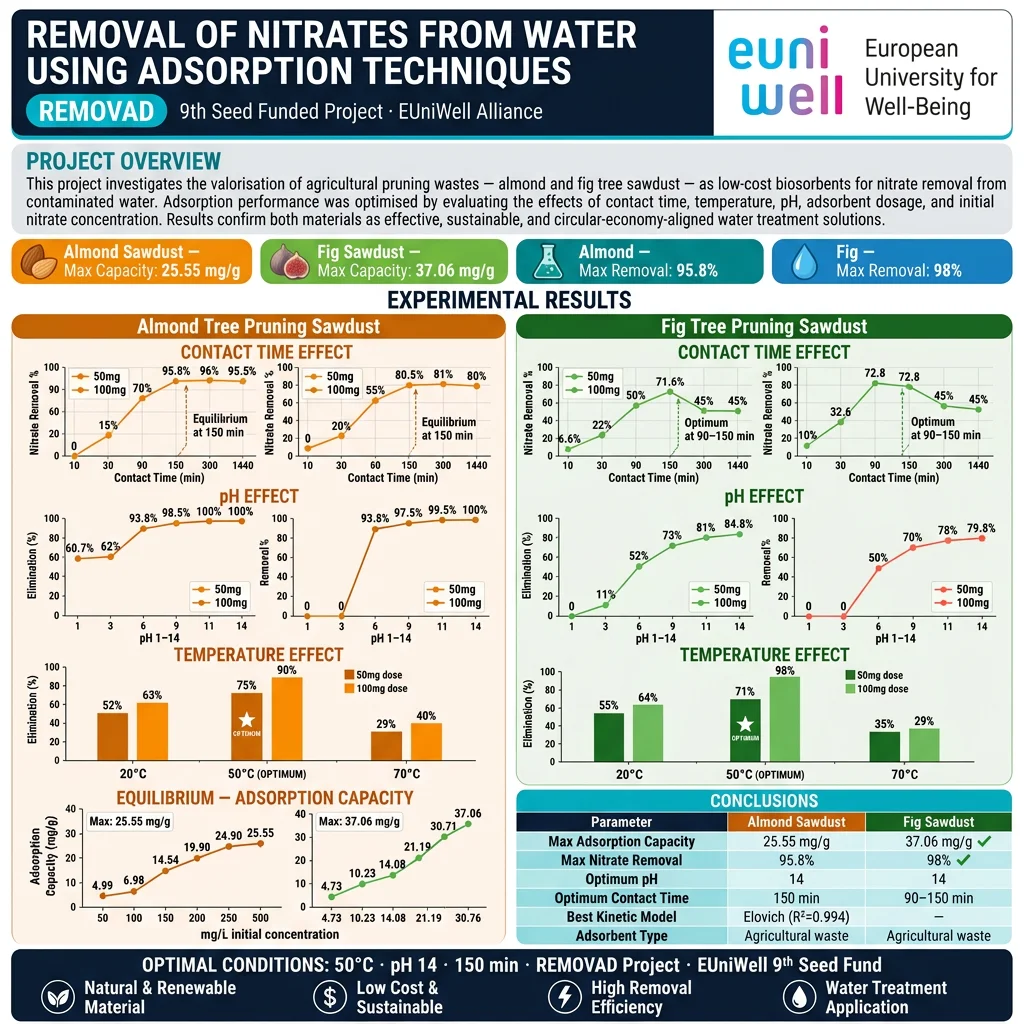
© Yesica Vicente Martínez
Contact persons:
- Yesica Vicente Martínez (Coordinator) , University of Murcia
- Parvaneh Eskandari, University of Birmingham
- Julia González Álvarez, University of Santiago de Compostela
- Adelina Adinolfi, University of Florence